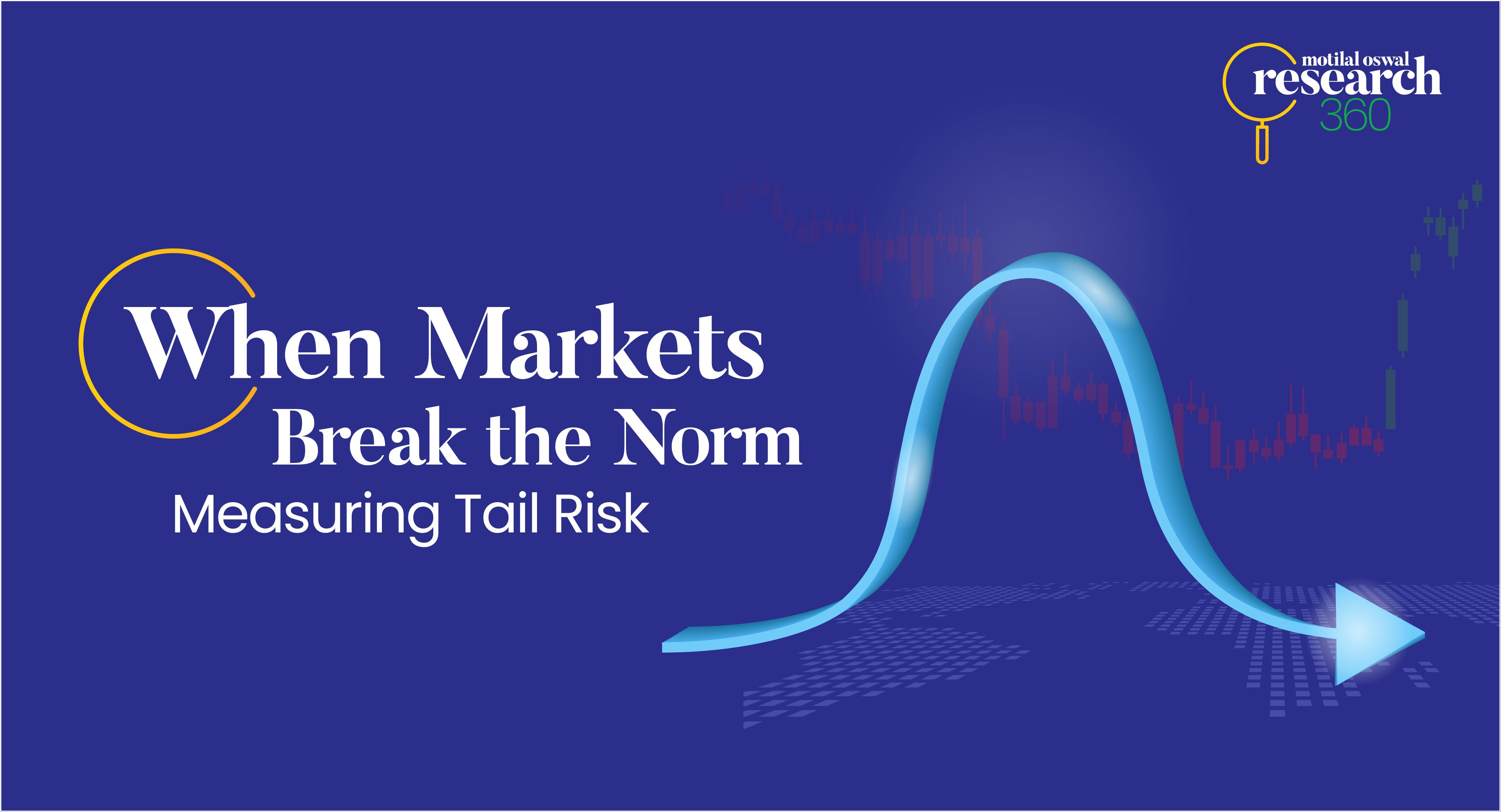
Tail risk refers to the probability of extreme events that lie outside the normal range of statistical returns on investments and can result in significant or catastrophic losses. In Indian equity markets, both the Nifty and the Sensex have experienced sharp drawdowns during such tail-risk events. Analysts often attempt to estimate the frequency and severity of these events using frameworks such as Extreme Value Theory (EVT).
Defining Tail Risk
The concept of tail risk arises from the presence of ‘fat tails’ in financial return distributions. Extreme deviations, typically defined as moves greater than three standard deviations from the mean, occur more frequently than predicted by standard Gaussian models.
Although tail risk primarily refers to the left tail of the distribution (downside risk), extreme upside moves can also affect portfolios, particularly those with short-option or leveraged exposures.
Studies on Indian equity markets, including Nifty 50 sectoral indices between 2006 and 2023, have applied EVT methods such as the Peak-Over-Threshold approach to estimate quarterly tail risk using a 5% threshold. The findings suggest statistically significant vulnerability during stress periods and evidence of interconnected market behaviour during systemic shocks.
Indian markets have witnessed several tail events over the past two decades.
During the 2008 Global Financial Crisis, the Nifty declined by nearly 60% from its January 2008 peak to its October 2008 trough amid severe global liquidity stress.
In March 2020, following the World Health Organisation’s declaration of COVID-19 as a pandemic on 11 March 2020, the Nifty fell approximately 38% from its January 2020 high to its March 2020 low within weeks. This period was marked by a sharp increase in volatility, rising kurtosis, and pronounced negative skewness. The nationwide lockdown announcement on 24 March 2020 and subsequent policy measures by the Reserve Bank of India helped stabilise conditions, but volatility remained elevated for an extended period.
On 24 August 2015, concerns over China’s currency devaluation triggered global risk aversion, leading to a fall of more than 1,600 points in the Sensex in a single session.
More recently, post-election uncertainty and earnings-related volatility in 2024 contributed to a meaningful market correction, accompanied by fluctuations in foreign institutional investor flows. However, attributing precise market value erosion solely to one factor would be overstated, as corrections typically reflect multiple domestic and global influences.
Each of these episodes demonstrates the persistence of tail risk. Empirical volatility modelling, including GARCH frameworks, shows that negative shocks tend to generate larger and more persistent volatility responses than positive shocks.
Measuring Tail Risk Probability
The probability of sharp downside moves is commonly estimated using 95%–99% Value at Risk (VaR) and Conditional Value at Risk (CVaR). While VaR estimates the maximum expected loss at a specified confidence level, CVaR measures the expected loss beyond that threshold, making it more suitable for tail-risk assessment.
Extreme Value Theory (EVT) models extreme observations separately from the main distribution and is therefore considered appropriate for analysing rare events. Methods such as the Peak-Over-Threshold approach and tail-index estimators are widely used in this context.
Empirical analysis of Nifty sector data (2006–2023) suggests that higher tail risk exposure may be associated with a risk premium, even after accounting for macroeconomic variables such as inflation and interest rates. This implies that investors demand compensation for bearing extreme downside uncertainty.
Options market data prior to COVID-19 indicated a steep volatility smile, reflecting elevated demand for out-of-the-money puts. March 2020 marked a structural break in volatility behaviour, with implied volatility and variance remaining elevated even after RBI interventions.
RBI Financial Stability Reports continue to highlight vulnerabilities in segments such as unsecured retail lending and fintech exposures. However, they do not publish explicit numerical probabilities of equity market tail events.
As of early 2026, Indian equities have delivered strong long-term performance over the past decade, despite intermittent corrections. However, several headwinds remain, including global monetary conditions, geopolitical tensions, oil price volatility, currency pressures, and valuation dispersion across sectors. Under adverse scenarios, corrections in the 10–20% range cannot be ruled out.
The Reserve Bank of India’s recent Financial Stability Reports have flagged cyber risks and stress in certain non-bank and fintech segments. While these risks do not directly translate into immediate equity market crashes, they may amplify systemic stress during broader external shocks.
Sector-level EVT analysis indicates that cyclical stocks tend to exhibit higher tail risk compared to defensive sectors such as consumer staples.
Measuring Tools and Methods
EWMA-based VaR models applied to Nifty and Sensex data perform reasonably during stable volatility regimes but may underestimate risk during contagion phases.
Extreme Value Theory and CVaR provide more robust estimates for extreme downside outcomes. Portfolio-level CVaR varies significantly across sectors and stock types, with higher-beta stocks typically exhibiting larger potential tail losses than defensive names.
GARCH(1,1) and related volatility models confirm clustering and persistence in NSE return series. When model coefficients approach unity, volatility shocks tend to decay slowly, indicating prolonged stress periods.
Regulatory stress testing frameworks incorporate multi-standard deviation shock scenarios to assess financial system resilience, though methodologies differ from those used in advanced economies.
Implications for Markets
Periods of elevated tail risk increase the likelihood of contagion across sectors and asset classes. Foreign institutional investors often respond quickly to global risk signals, which can amplify domestic volatility through capital flow adjustments.
Evidence suggests that sectors with lower tail exposure may attract relatively stronger capital flows during uncertain periods, leading to defensive rotation.
The Reserve Bank of India and the Securities and Exchange Board of India conduct stress assessments to evaluate systemic resilience. While gross non-performing asset (GNPA) ratios in the banking sector have improved in recent years, unsecured retail lending remains an area of monitoring due to its sensitivity during downturns.
Mitigation Strategies
Tail risk cannot be eliminated, but it can be managed.
Protective put options and structured hedging strategies can reduce exposure to severe downside moves, though they may be costly during low-volatility regimes. Diversification into assets with low correlation to equities, such as gold, can help reduce Conditional Value at Risk.
Dynamic volatility-adjusted risk models and scenario-based stress testing, for example, modelling a 15–20% Nifty decline, allow investors to assess portfolio vulnerability under extreme conditions.
*The article is for information purposes only. This is not investment advice.


 Join Telegram